


Blogs


How a Leading Meat Producer Eliminated Retailer Load Rejections with Real-Time Cold Chain Monitoring
Executive summary
A multibillion-dollar North American meat producer was facing rejections of high-value shipments to load rejections at one of the country’s largest retailers. The root cause was not the product or the cold chain itself — it was a lack of visibility. The producer’s legacy radio frequency (RF) temperature loggers only reported data after a truck reached the retailer’s distribution center. If a device failed silently in transit, the retailer had no temperature record on arrival and rejected the load on the spot. For meat, rejection is immediate, and a single truckload can be worth up to $300,000.
When the retailer opened its approved-vendor program to competition after six years of a single incumbent, the producer moved quickly to DeltaTrak’s real-time cold chain monitoring. Within roughly four weeks it was shipping on the new solution, and it rolled the program out across ten sites. The defining change: teams could now confirm a device was recording before a truck left the building and track temperature and location in transit. Since the switch, the producer has reported reduced rejections on those lanes.
Customer background
The customer is a multibillion-dollar, publicly traded meat producer that ships temperature-sensitive protein to major national retailers. Meat carries some of the strictest temperature criteria in food distribution, which raises the stakes on every shipment. The producer operates numerous plants and distribution centers and had partnered with DeltaTrak for over twenty years — first on paper chart recorders, later PDF passive loggers, and even a private-label recorder for one of its turkey brands. That long-standing, trust-based relationship set the stage for what came next.
The challenge: shipping blind to a compliance-driven retailer
For more than a decade, shippers into this retailer relied on RF loggers from the incumbent provider. RF loggers are passive in transit: they record temperature but transmit nothing until they reach a gateway reader at the retailer’s distribution center.
That created a visibility gap with real financial consequences. The producer’s shipping teams would activate a logger, confirm a small blinking light, photograph the device as proof of activation, and attach the photo to the bill of lading. From that moment until arrival, the shipment was effectively invisible. If the device wasn’t functioning when the retailer’s gateway tried to read it, there was no temperature record — and no record meant an automatic rejection.
Why did previous methods fell short:
• No in-transit visibility. The shipper could not confirm a device was recording once the truck departed.
• Failures surfaced too late. Problems were discovered at the receiving dock, not on the shipping dock — when nothing could be done.
• Rejections are expensive. A rejected meat load turns around and ships back at a cost of thousands of dollars, then must be reworked or sold at a lower price, with product quality degrading along the way. Individual loads can be valued as high as $300,000.
• Proof was manual. A photograph of a blinking light is a fragile substitute for a live, verifiable record.
This is not an isolated case. Increasingly strict retailer cold chain compliance requirements — and growing demand for real-time visibility — are pressuring large meat processors that ship to the biggest national grocers. The producer’s situation reflects a broad industry shift.
Why change happened now
Two forces converged. First, the retailer ran a competitive RFP and approved multiple monitoring vendors, ending a six-year single-vendor arrangement. Shippers suddenly had a choice. Second, prices moved to parity: real-time loggers had historically cost more than RF devices, but once the program opened, that premium disappeared. With a membership discount applied, the real-time option with pricing parity per device — at or below the alternatives on the approved list. The decision math became simple. For the same cost or less, the producer could move from an afterthe- fact record to real-time assurance. As the DeltaTrak team summarized the customer’s reasoning:
“I want the new technology because I can protect myself better. I can prove the recorders are working in the cloud before they even leave my building — and I’m no longer dependent on the readers in the retailer’s warehouses.”
Real-time temperature logger vs. data logger — the distinction that mattered
A passive data logger (including RF loggers) records temperature but only surfaces it when it’s physically read at the destination. A real-time logger transmits temperature and location over cellular networks throughout the journey, so shippers see conditions as they happen and can act mid-transit. For a producer being rejected for missing records, that difference was decisive.
The solution: real-time cold chain monitoring on the UBQ Network
The producer adopted DeltaTrak’s real-time cellular loggers, feeding data into the UBQ Network platform. Three capabilities addressed the exact failure points above.
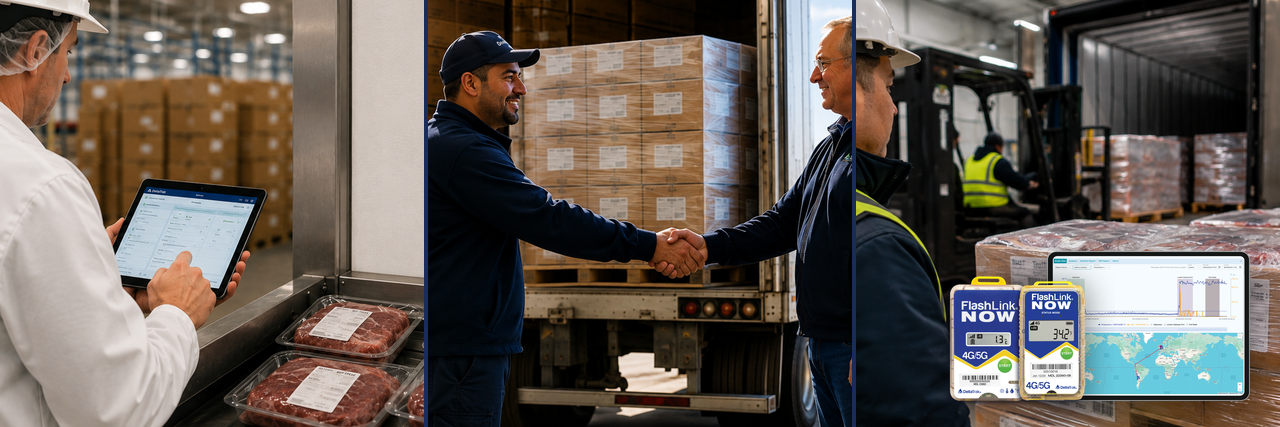
1. Pre-shipment validation. Unlike RF devices, the real-time loggers carry an LCD screen that clearly shows the device is recording, and their status can be confirmed in the cloud before the truck departs. Teams no longer ship on faith and a photograph — they verify.
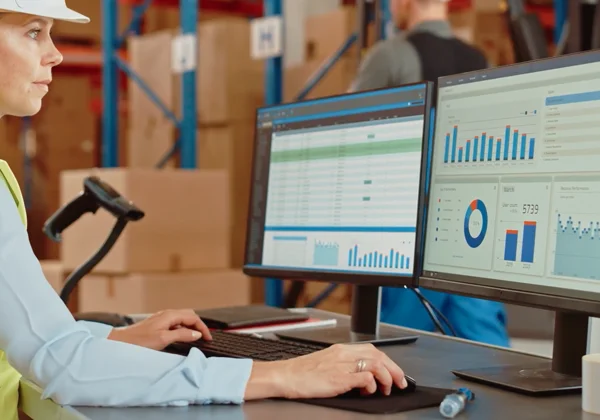
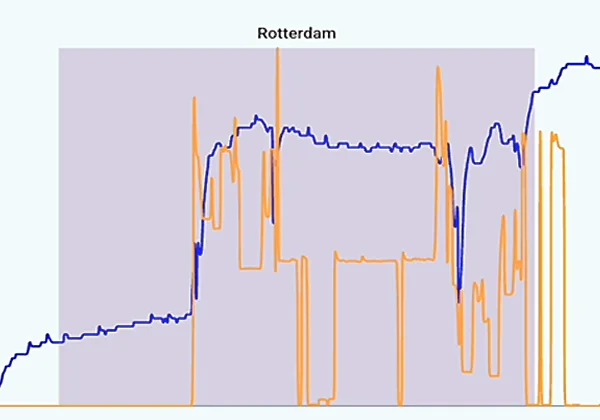
2. In-transit temperature and location visibility. The producer can now see conditions and location throughout the trip rather than waiting for a dock read. Failures become manageable events, not endof- trip surprises.
3. Geofencing and automated arrival reporting. When a truck crosses a geofence at the destination, the retailer’s quality team automatically receives a quality report — at arrival, not when the dock doors finally open. The shipper also gains confirmation of exactly when the truck arrived, useful when loads are held at a facility.
Implementation reflected DeltaTrak’s operational expertise. Working with the Cloud Services team, DeltaTrak rolled out ten sites — plants and distribution centers — over the course of about a month, training each location individually. Training covered activating and confirming a recording device, selecting the correct retailer-specific device profile in UBQ, entering required data such as the retailer PO and shipping location, following the retailer’s logger placement rules, and troubleshooting cellular connectivity at remote facilities. From decision to first live shipment took roughly four weeks.
The rollout was structured in three phases: first, all shipments to the primary retailer; next, shipments to a second major grocer; and finally, expansion to additional receivers. For the highest-volume lanes — one distribution center ships around 80 truckloads a day to a single grocer — DeltaTrak is implementing API integration to replace manual device entry, which can otherwise occupy a staff member for most of a day.
The results
The producer’s central goal was to eliminate rejections and become a stronger partner to its retailer. On that measure, the early outcome is clear.
• No further load rejections reported on the converted lanes since going live.
• Verification moved upstream — from the receiving dock to the shipping dock — closing the visibility gap that caused failures.
• Faster, proactive arrival reporting through geofencing, giving both shipper and receiver information sooner.
• A fast, low-friction switch: ten sites live in about a month, first shipments within roughly four weeks, with no cost or training obstacles because the device carried the lowest price on the approved list and delivered immediate benefits.
Detailed metrics — rejection-rate percentages, dollar savings, compliance-score movement — are still being compiled; the account now has about six months of data, and a formal review is underway. Early leadership feedback has been positive, particularly regarding the platform’s map features and real-time visibility.
The natural next step: from monitoring to intelligence
Eliminating rejections is the foundation. The larger opportunity is turning shipment data into a competitive advantage. Through UBQ Membership, the same real-time data can power a Shipper Dashboard that lets a producer pull up every shipment to a given retailer and demonstrate, proactively, that loads arrived in good condition — turning compliance into a relationship-strengthening, businesswinning proof point. Additional UBQ services extend that further into trip segmentation, freshness intelligence, and carbon reporting compliance.
For any meat or perishable-food shipper facing rejections, chargebacks, or tightening retailer requirements, the lesson is straightforward: real-time visibility is no longer a premium add-on — it is the cost of being a trusted supplier.
Learn how the latest generation of UBQ Services can help your organization improve visibility, reduce risk, and optimize cold chain operations.
Membership
FAQs:
What is real-time cold chain monitoring?
Real-time cold chain monitoring uses cellular-connected loggers to transmit temperature and location data continuously throughout shipment. Shippers can see conditions and act while goods are still in transit — rather than reviewing data only after delivery.
How is a real-time logger different from an RF or passive data logger?
A passive or RF logger records temperature but only surfaces the data when it’s physically read at the destination.
A real-time logger transmits data over cellular networks throughout the trip, enabling preshipment validation, in-transit alerts, and proof of condition on arrival.
Why do retailers reject meat loads?
Meat carries strict temperature criteria, and major retailers require a valid temperature record. If a monitoring device isn’t functioning when the retailer reads it on arrival, there is no record — and the load is typically rejected immediately. Produce is often handled differently: it may be inspected against arrival standards and penalized rather than rejected outright.
What does a rejected load actually cost?
Beyond the shipping cost to return the load (thousands of dollars), there’s rework, potential resale at a lower price, and degraded product quality. For high-value meat, individual loads can be worth up to $300,000.
How long does it take to switch to real-time monitoring?
In this case, the producer went from decision to first live shipment in about four weeks and rolled out ten sites in roughly a month, supported by individualized site training from DeltaTrak’s Cloud Services team.
Do we need API integration?
Not to start. Manual device entry works for standard volumes, but high-volume lanes (for example, a distribution center shipping ~80 truckloads a day) benefit from API integration to eliminate hours of manual data entry.
What is geofencing in cold chain monitoring?
Geofencing creates a virtual boundary at a location. When a shipment crosses it, the system can automatically trigger actions — such as sending an arrival quality report to the receiver — and confirm exactly when a truck arrived.
What is the UBQ Shipper Dashboard?
It’s a real-time cold chain monitoring software that consolidates shipment performance so a shipper can prove to a retailer that loads arrived in good condition, strengthening the supplier relationship and supporting more business.

F. Robert Bright
Mr. Bright joined DeltaTrak in 2003. With 34 years of industry experience, he has worked closely on cold chain solutions for Fortune 500 companies across industries, specializing in produce.