

Blogs


Every Load, Every Mile: How Continental Fresh Built Cold Chain Visibility Across a Partner Network
Executive summary
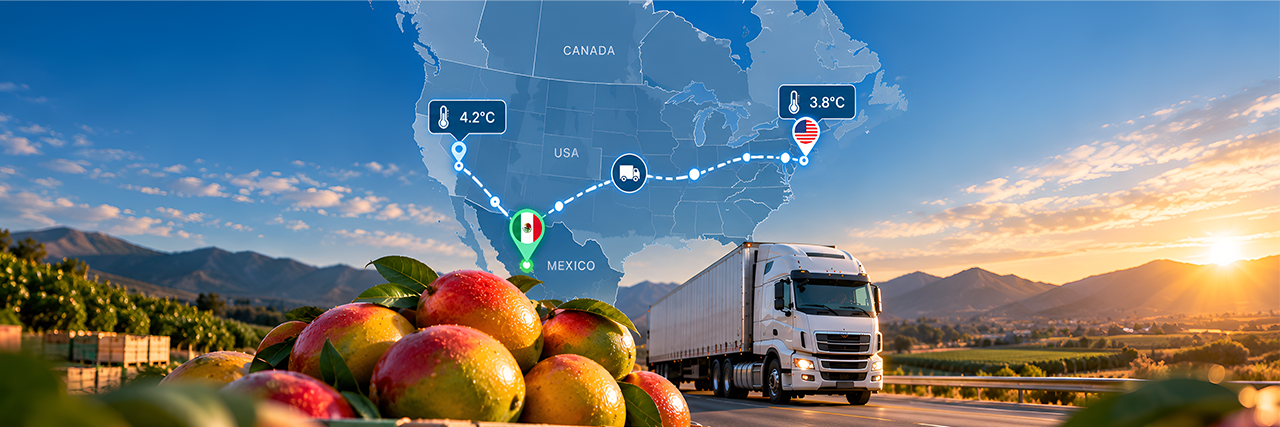
Continental Fresh moves year-round mangoes and seasonal cucumbers and squash from partner growers in Mexico, Central and South America to retail, wholesale, processor and foodservice buyers across the United States and Canada. The company operates through third-party trucks and receiving warehouses — a model that keeps it fast, focused on sourcing and close to its customers, and one that puts a premium on having independent visibility into freight it does not physically control.
Continental Fresh has logged temperature in transit for more than a decade, well ahead of what documentation under the FDA Food Safety Modernization Act (FSMA) required. Those records did their job. What they could not do was show where a load was while it was still moving.
In 2024, Continental Fresh moved to DeltaTrak real-time loggers on the UBQ Network platform, placing a 400-unit order directly after a live demonstration. Usage grew to roughly 2,600 units in 2025, with about 2,200 deployed through the first eight months of 2026. Today a tracker goes on every load — not only the high-value ones.
Customer background
- • Company: Continental Fresh
- • Industry: fresh produce import and distribution
- • Commodities: year-round mangoes, seasonal cucumbers and squash
- • Model: asset-light, operating through third-party warehouses and trucks
- • Network: partner growers in Mexico, Central and South America; a contracted cross-dock near the Texas border; contracted domestic carriers
- • Customers: retail, wholesale, processor and foodservice buyers across the United States and Canada
- • Typical load value: approximately $15,000 to $70,000, mixing full truckloads and LTL
- • Typical transit: 2 to 6 days
- • Volume: more than 2,000 tracked loads a year, seasonal by commodity
- • Relationship with DeltaTrak: since 2024
The challenge: accountability across a partner network
An importer that does not control the transportation chain still owns every commitment made to the buyer. At Continental Fresh, the fruit is grown by a partner, consolidated at a partner cross-dock and hauled by a contracted carrier — and the company holds itself accountable for all of it. When a load runs late or arrives warm, the consequence lands with the importer, even though the levers sit with somebody else.
“They rely on partner companies to handle everything. That’s why it’s so important for them to have the visibility.” — Andres Toro, Sales Director, DeltaTrak
The practical version was simple. It was never their truck driver, so they could never just call the truck driver. Checking on a load meant calling a partner, waiting, and relying on the answer — a chain of phone calls, emails and text messages routed through people who were not accountable to the Continental Fresh customer waiting at the other end.
Asked which part of the shipment mattered most to the business, the DeltaTrak team did not name product loss or claims. They named location. Buyers expect arrival windows, and Continental Fresh wanted a way to confirm one directly rather than wait for the truck to appear at the dock.
From records to real time
A data logger is passive: it captures temperature in transit and is read at the destination. That is enough for documentation, and Continental Fresh had done it rigorously for years. A real-time logger transmits temperature and location while the shipment moves, so conditions can be acted on before delivery rather than explained after it.
Continental Fresh moved toward real-time monitoring early, before cross-border device technology had caught up with the lane. At the time, separate device types were required for Mexican and US cellular networks — two inventories to manage for a single route. The requirement was a limitation of the technology available, not of the company’s ambition for its cold chain.
The solution: one device, one lane, one view
A long-standing relationship earned DeltaTrak the meeting; the demonstration won the order. After seeing the platform work, Continental Fresh placed a 400-unit first order and began deploying immediately. There were no extended pilots and no gradual ramp-up — the decision of a team that knew precisely what it needed to see.
Three decisions shaped the deployment:
- • Multi-network devices. A single DeltaTrak logger operates across 2G, 4G and 5G networks, so one device covers the full Mexico-to-US journey. This removed the dual-inventory problem entirely.
- • Single-use loggers. With 2-to-6-day transits ending at independent partner facilities, recovering a reusable device is impractical. Single-use matches the asset-light model.
- • Wi-Fi-assisted positioning. Cellular triangulation alone can be imprecise. DeltaTrak devices fall back to Wi-Fi as a second positioning source, which improves location accuracy — the attribute Continental Fresh weighted most heavily.
The workflow around it is deliberately lean. An operations manager at headquarters orders devices in blocks of 500 ahead of each season and handles critical alerts. At the border cross-dock, a coordinator logs in daily, creates each shipment against its purchase order, assigns a tracker, and watches for temperature excursions or missing location data. Alerts arrive by email. Migration from the legacy FlashTrak platform to UBQ Network required no customization and a single training session.
Results
- • 6.5x growth in deployment in the first full year. From a 400-unit first order to approximately 2,600 units in 2025, with roughly 2,200 units already deployed in the first eight months of 2026.
- • 100% load coverage. Trackers go on every shipment, not selectively on high-value freight — a decision a business makes only once it trusts the data operationally.
- • Fewer outbound status requests. Staff confirm border arrival and in-transit position in the platform instead of calling partners.
- • One consolidated device inventory across both countries, replacing the two-device approach the previous system required.
- • Exception-based management. Silence from the platform is now information: no alert means the load is running as planned.
- • Unprompted referrals. Continental Fresh has referred DeltaTrak to peers in the produce trade, several of whom have taken demonstrations.
Continental Fresh measures the program the way an operating team does — by how far it has been trusted. Coverage went to every load, purchasing repeated at scale across three seasons, and the company recommends the platform to peers without being asked. All three are strong signals.
“Now they can look at the platform and see where it is and then call the person who’s responsible at that time. They don’t have to guess.” — Andres Toro, Sales Director, DeltaTrak
Frequently asked questions
What is the difference between a data logger and a real-time logger? A data logger records temperature during transit and is read after delivery. A real-time logger transmits temperature and location while the shipment moves, allowing intervention before the load arrives. Data loggers answer questions about the past; real-time loggers support decisions in the present.
Does real-time monitoring make sense if I do not own my trucks or warehouses?
That is often where it matters most. When freight moves through partner facilities and contracted carriers, independent data is the most direct line of sight a shipper has into its own product.
Do I need separate devices for shipments crossing between Mexico and the United States?
Not with a multi-network device. DeltaTrak real-time loggers operate across 2G, 4G and 5G, so one device covers the full cross-border journey and one inventory covers the lane.
Should trackers go on every load or only high-value shipments?
Both approaches are used. Continental Fresh tracks every load, which simplifies the process: no decision at loading, and no shipment without a record. Loads here typically carry $15,000 to $70,000 of product.
How long does implementation take?
Continental Fresh moved from demonstration to a 400-unit order and began deploying immediately. Training was a single session, and no customization was required.

F. Robert Bright
Mr. Bright joined DeltaTrak in 2003. With 34 years of industry experience, he has worked closely on cold chain solutions for Fortune 500 companies across industries, specializing in produce.