




Blogs


Why Two Seemingly Identical Strawberry Shipments Don’t Last the Same: A Postharvest Expert on Shelf Life, Temperature and FreshIDX
Executive summary
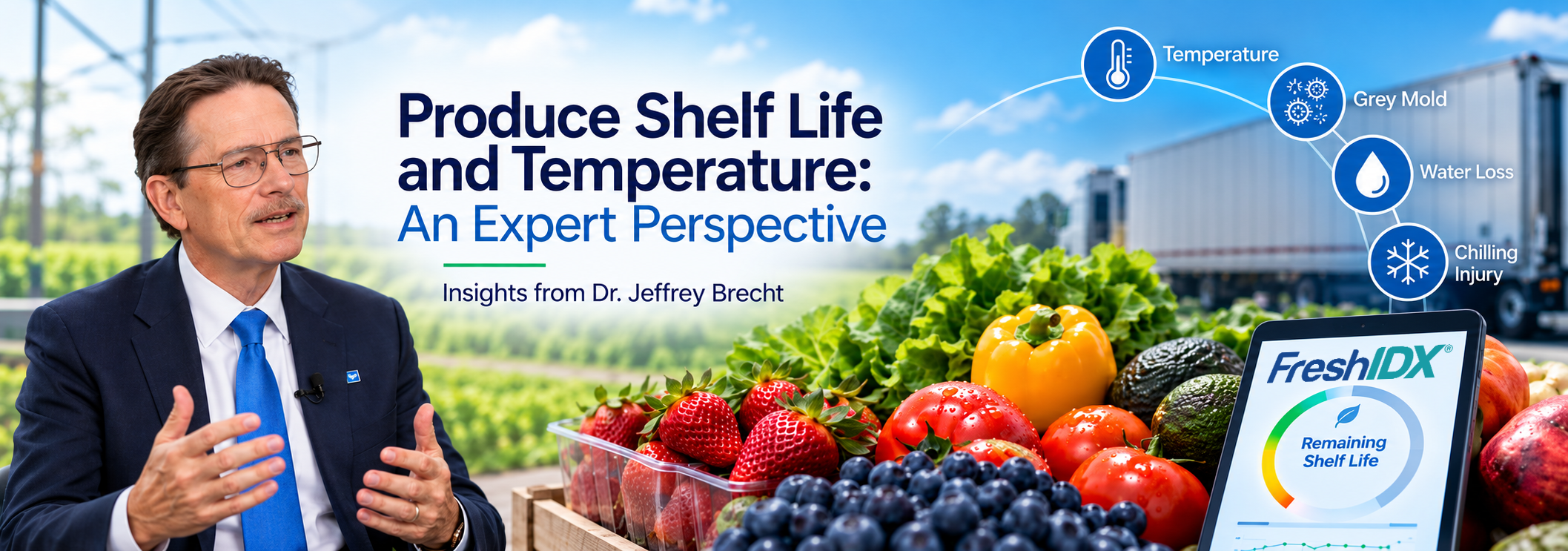
Temperature is the single biggest factor in how long fresh produce lasts after harvest. That was the core message from Dr. Jeffrey Brecht, emeritus professor at the University of Florida, when DeltaTrak interviewed him at its booth on day 2 of the IFPA Global Produce & Floral Show 2026.
Dr. Brecht has studied postharvest plant physiology for more than 40 years and has used DeltaTrak data loggers in his research for more than 20 years. Key takeaways from the interview:
- • Every quality change is a chemical reaction. Color, gloss, browning, softening and aroma loss all speed up as temperature rises and slow down as it falls.
- • Grey mold (Botrytis cinerea) grows slowly even under proper refrigeration. It gets a head start in the cold chain and spreads quickly once produce warms up on display or at home.
- • Water loss shows up in two stages. First the surface turns dull and loses its gloss. Then it shrivels and wrinkles. Packaging is the main defense.
- • Colder isn’t always better. Chilling-sensitive crops such as bananas, avocados, peaches, melons, mangoes and tomatoes can be damaged by temperatures that are too low. Loss of aroma, or tasteless fruit, is often the first symptom.
- • Every commodity has a maximum shelf life, and every handling decision affects it. Each product starts with a potential shelf life, and any deviation from optimum handling reduces it.
- • The Freshness Index (FreshIDX) turns temperature data into shelf-life decisions. It estimates how much shelf life a shipment has lost and when the first defect is likely to appear. Retailers, growers and shippers can then route product by remaining freshness rather than arrival order alone.
About the expert: Dr. Jeffrey Brecht
Dr. Jeffrey Brecht is an emeritus professor at the University of Florida, where he spent more than 40 years researching and teaching postharvest plant physiology.
Postharvest plant physiology is the science of what happens to fruits and vegetables after harvest, including ripening, quality loss and decay. Dr. Brecht’s work focuses on identifying what causes those changes and which handling practices minimize quality losses.
His relationship with DeltaTrak spans more than 20 years. It began with DeltaTrak data loggers, which he used extensively to simulate storage and transportation conditions in his research. Over time, that collaboration expanded into shelf-life studies, research on how transportation practices affect remaining shelf life, and work with retailers on decisions about produce sourced from around the world.
“My job has been to determine what causes those things and what are the optimal handling practices that should be followed to minimize losses in quality.” — Dr. Jeffrey Brecht
Why does fresh produce deteriorate after harvest?
Fresh produce deteriorates because chemical reactions keep running after harvest, and temperature controls how fast they run. Lower temperatures slow these reactions. Higher temperatures speed them up.
“At the most basic level, all of the changes taking place in fruits and vegetables that we can see, taste and feel in their texture are chemical reactions.” — Dr. Jeffrey Brecht
The goal of postharvest handling is to keep produce as close as possible to its quality at the moment of harvest. Dr. Brecht groups the quality changes into three categories:
| Quality attribute | What changes | What the buyer notices |
|---|---|---|
| Appearance | Color, surface gloss, browning and discoloration | Dull, faded or browned product |
| Texture | Firm tissue softens | Produce that is soft or mushy instead of firm |
| Flavor and aroma | Synthesis of characteristic aroma compounds | Produce that tastes flat or bland |
Aroma deserves special attention. The aroma compounds a fruit produces are a major part of the eating experience, and they are among the first attributes lost when handling goes wrong.
Why do two seemingly identical shipments have different shelf lives?
Consider two strawberry shipments from the same lot, harvested on the same day, with the same cut-to-cool time. The only difference is the truck that carries them. Those two shipments can still reach the store with very different shelf lives.
The reason is temperature history. Each truck exposes its load to its own temperature conditions in transit, and those differences change the rates of chemical change, water loss and decay. Shipments that look identical at the start of the cold chain can be very different by the end of it.
The 3 most common quality risks in the produce cold chain
Three risks came up in the interview: decay, water loss and chilling injury. Each commodity has its own most important quality attributes and its own best handling practices, so these risks affect crops differently.
1. Decay: grey mold (Botrytis cinerea)
Most fruits and vegetables are naturally resistant to decay, and only a few microorganisms can cause it. Of those, grey mold, caused by the fungus Botrytis cinerea, is probably the most common and most serious postharvest pathogen, according to Dr. Brecht.
It affects a wide range of produce, including strawberries and other small fruits, lettuce, broccoli and tomatoes.
What makes grey mold so damaging is its ability to grow at low temperatures. Even under proper refrigeration it grows slowly, which gives it a head start. When produce warms up, such as on a grocery display, the mold can spread very quickly. Consumers often don’t see the visible, fluffy mycelium until the product is already home.
“The lower you can keep the temperature at every step in the distribution system, up until it reaches the consumer, the farther off that final growth will be.” — Dr. Jeffrey Brecht
2. Water loss: from dull to shriveled
Produce continues to lose water after harvest, and that water loss changes appearance and texture. It shows up in two stages:
- 1. Loss of gloss. The surface turns dull. Freshly harvested strawberries are bright and shiny, so a dull berry is the first visible sign of water loss.
- 2. Shriveling. As water loss becomes more severe, the surface wrinkles and shrivels.
Temperature also drives water loss. At the same humidity, produce at a higher temperature loses more water.
Packaging is the main defense. One of its core purposes is to reduce water loss by shielding produce from the outside environment. Differences in how well packaging controls water loss explain some of the variation buyers see in the same product.
3. Chilling injury: colder isn’t always better
Chilling injury is damage caused when chilling-sensitive produce is held at temperatures that are too low for that commodity. The cold chain usually aims to lower temperature as far as possible to slow chemical reactions. For chilling-sensitive crops, going too low causes its own damage.
Dr. Brecht’s research found that the first symptom of chilling injury is very often loss of aroma.
“When you taste produce and it seems tasteless, it’s very often because it was exposed to the wrong temperature.” — Dr. Jeffrey Brecht
Crops he named as chilling sensitive include bananas, avocados, peaches, melons, mangoes and tomatoes.
The takeaway: the right temperature is commodity specific. It should be as low as the product tolerates, and no lower.
How the Freshness Index (FreshIDX) predicts remaining shelf life
The Freshness Index (FreshIDX) applies commodity-specific postharvest science to a shipment’s temperature history. From that history it estimates how much shelf life has been lost and predicts when the first quality defect is likely to appear.
Every commodity has a maximum shelf life. Every handling decision affects it.
Potential shelf life is the maximum shelf life a fruit or vegetable can reach if it is handled under ideal conditions from the start of its postharvest life. Remaining shelf life is what is left after the conditions it actually experienced.
Any deviation from optimum handling reduces potential shelf life, and temperature is by far the most important factor. It affects every chemical reaction behind appearance, texture and flavor, and it affects water loss too.
“Temperature really is the number one thing by far, because it affects everything else.” — Dr. Jeffrey Brecht
Every commodity has its own physical defect that limits practical real-world shelf life.
A shelf-life limiting factor is the first quality attribute or physical defect to become unacceptable, which ends a product’s practical, real-world shelf life. It differs by commodity, so predicting shelf life requires knowing, for each fruit and vegetable:
- 1. Which quality problems tend to appear, and in what order
- 2. How temperature affects each one
Strawberries show how this works. Decay is most commonly the first factor that limits their shelf life. Loss of gloss and shriveling from water loss follow, along with bruising symptoms if the berries were bruised.
What FreshIDX calculates
FreshIDX packages this commodity-specific knowledge into a calculation that tells the customer two things:
- • Shelf life already lost through handling activities in the supply chain
- • When the first physical defect is likely to appear
“If you know that interrelationship between temperature and quality, you can predict what any deviation from optimum conditions is going to do in terms of shortening the potential shelf life.” — Dr. Jeffrey Brecht
How to use FreshIDX to optimize cold chain decisions
FreshIDX helps cold chain partners decide where and when to send product based on how much shelf life each shipment has left. Dr. Brecht’s recommended path has three steps.
Step 1: Measure and document temperature
The foundation is temperature data. Organizations need to measure and document temperature in their own operations and build a body of data on the conditions in their system. That data alone can point to handling practices that need improvement.
Step 2: Quantify shelf-life loss for each shipment segment
With temperature data in place, FreshIDX shows whether each shipment has lost shelf life under the conditions it experienced. That turns temperature records into a measure of product quality.
Step 3: Make logistics decisions based on remaining shelf life
Once shelf-life loss is visible, retailers and suppliers can act on it.
For retailers: go beyond first in, first out. Distribution centers typically rotate stock first in, first out (FIFO). When a retailer receives multiple loads of the same product, some may have less remaining shelf life than others. FreshIDX helps decide where each load should go and how soon. A load that arrived later may need to skip the line and ship sooner so consumers receive it at its best. Prioritizing by remaining shelf life is often called first expired, first out (FEFO).
“Maybe something that came in a little later should skip the line and go out sooner, so that the consumers receive it in the best possible quality.” — Dr. Jeffrey Brecht
For growers and shippers: match product to destination. The same logic applies further upstream. Pre-harvest conditions and how quickly produce was cooled to the proper temperature both affect shelf life. With that knowledge, a grower or shipper can send shorter-lived product to closer customers and longer-lived product to more distant ones, so that every customer receives the best quality on average.
Frequently asked questions
What is the most important factor in produce shelf life?
Temperature. According to postharvest physiologist Dr. Jeffrey Brecht, it is the number one factor by far. It controls the rate of the chemical reactions behind color, texture and flavor changes, and it affects how fast produce loses water.
Why does mold appear on strawberries soon after I bring them home?
Grey mold (Botrytis cinerea) can grow slowly even at proper refrigeration temperatures. That gives it a head start during distribution. Once berries warm up on a store display or at home, the mold spreads quickly and its fluffy growth becomes visible.
What is the first sign of water loss in produce?
A dull surface. Produce loses its natural gloss first, and shriveling or wrinkling follows as water loss becomes more severe. Strawberries are a clear example, since fresh berries are bright and shiny.
Can produce be stored too cold?
Yes. Chilling-sensitive crops, including bananas, avocados, peaches, melons, mangoes and tomatoes, can suffer chilling injury when held below their commodity-specific safe temperature. The first symptom is often loss of aroma, which makes the produce taste bland.
Why does fruit taste bland?
Fruit often tastes bland because it was exposed to the wrong temperature after harvest. In chilling-sensitive crops, temperatures that are too low suppress the aroma compounds that give fruit its characteristic flavor.
What is the Freshness Index (FreshIDX)?
FreshIDX is part of DeltaTrak’s UBQ Network. It applies commodity-specific postharvest science to a shipment’s temperature data to estimate how much shelf life has been lost in the supply chain and to predict when the first quality defect will appear.
How does FreshIDX improve on first in, first out?
First in, first out ships product in order of arrival. FreshIDX lets retailers prioritize by remaining shelf life instead, so a later load with less shelf life left can ship first and reach consumers in the best possible condition.
Turn temperature data into freshness decisions
Every shipment carries a temperature history, and that history determines how much shelf life reaches the shelf. Measuring it is the first step. Turning it into shelf-life predictions is how cold chain teams protect quality, reduce waste and deliver better produce to consumers.
Learn how the latest generation of UBQ Services can help your organization improve visibility, reduce risk, and optimize cold chain operations:

Karl McDermott
Currently the Chief SaaS Officer of DeltaTrak and the General Manager of the UBQ Network, a digital marketplace for Ag Food. Previously he held leadership positions at a Canadian SaaS freight tech provider, a SaaS truck load matching platform, and a last mile logistics firm. Karl was a recipient of Mexico’s innovation award 2018.